FD Calculator

💰 Calculate your Fixed Deposit maturity amount, interest earned, and total value.

Principal
₹0
Interest Earned
₹0
Maturity Amount
₹0
Growth of FD over tenure.
Principal vs Interest earned.
Note: Actual bank FD rates, compounding rules and TDS may vary.

What is FD (Fixed Deposit)?

A Fixed Deposit (FD) is a secure investment option offered by banks and financial institutions that allows you to invest a lump sum amount for a fixed period at a predetermined interest rate. Unlike market-linked instruments, FD returns are guaranteed and risk-free, making them one of the most trusted savings avenues in India.
You earn interest on your deposit based on the tenure and compounding frequency chosen — monthly, quarterly, or yearly. At maturity, you receive your principal plus interest, making FDs ideal for short-term and long-term goals such as emergency funds, education, or retirement planning.

What is an FD Calculator?

An FD Calculator is an online tool that helps you calculate the maturity amount and interest earned on your fixed deposit. It instantly estimates how much your investment will grow over a specific period at a given interest rate, without needing manual calculations.
Using Business Day’s FD Calculator, you can simply enter your deposit amount, tenure, and interest rate to know exactly how much you will receive at maturity — giving you clarity and confidence before investing.

How can an FD Calculator help you?

A Fixed Deposit Calculator offers several advantages for both beginners and experienced investors:

  • Instant insights: Quickly calculate your returns without complex formulas.
  • Investment planning: Compare FDs of different tenures or banks to find the best rate.
  • Transparency: Understand how compounding impacts your total maturity value.
  • Goal tracking: Estimate how much you need to deposit today to achieve a specific future amount.
  • Time-saving: Avoid manual interest calculations — results are shown instantly.

With the Business Day FD Calculator, you can plan deposits strategically and align them with your short-term or long-term financial goals.

How does an FD Calculator work?

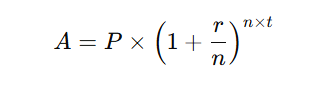
An FD calculator uses the compound interest formula to determine your maturity amount:

📘 Compound Interest Formula
FD Calculator

Where:

  • A = Maturity Amount (Principal + Interest)
  • P = Principal (initial deposit)
  • r = Annual interest rate (in decimal)
  • n = Number of compounding periods per year
  • t = Tenure (in years)

If the interest is simple, the formula used is:

A=P×(1+r×t)

Example Calculation:

ParameterValue
Principal (P)₹1,00,000
Annual Interest Rate (r)7.5%
Tenure (t)5 years
CompoundingQuarterly (n = 4)

Formula:
A = 1,00,000 × (1 + 0.075 / 4)<sup>4×5</sup>
A = ₹1,44,893

Calculation TypeAmount
Principal₹1,00,000
Interest Earned₹44,893
Maturity Amount₹1,44,893

Thus, an investment of ₹1 lakh at 7.5% for 5 years (quarterly compounding) earns ₹44,893 as interest.

How to use Business Day FD Calculator?

Using the Business Day FD Calculator is effortless:

  1. Enter the Deposit Amount — the lump sum you wish to invest.
  2. Enter the Interest Rate — the annual rate offered by your bank or NBFC.
  3. Select Tenure — choose the investment duration in years or months.
  4. Choose Compounding Frequency — yearly, quarterly, or monthly.
  5. Click “Calculate FD” — the tool instantly displays:
    • Principal invested
    • Interest earned
    • Maturity value
    • Interactive charts showing your FD growth and return composition

This calculator can also factor in senior citizen rates and multiple compounding options to provide realistic, precise results.

Advantages of using Business Day FD Calculator

  • Free and instant: No registration or charges — results appear in real time.
  • Compare returns: Evaluate different banks or schemes before investing.
  • Accurate projections: Uses real compounding formulas for precise estimates.
  • Financial clarity: Understand the true potential of your FD investment.
  • Safe and reliable: 100% browser-based tool — no data storage or tracking.
  • Responsive design: Works smoothly on desktop, tablet, and mobile devices.

The Business Day FD Calculator empowers investors to make informed, data-driven decisions — whether you’re securing your savings or planning your next financial milestone.

Fixed Deposit (FD) – Frequently Asked Questions

What does FD mean?
FD stands for Fixed Deposit. It is a savings/investment product offered by banks and NBFCs where you deposit a lump sum for a fixed period and earn a fixed rate of interest. The rate does not change during the tenure.
Which bank gives 9.5% interest on FD?
Public sector banks rarely offer 9.5% today. Such high rates, when available, are usually from small finance banks, co-operative banks or for special tenures and only for senior citizens. Always check the latest rate on the bank’s official website before investing.
Which bank is best for FD?
“Best” depends on what you want — highest interest, highest safety, or flexible payout. Large banks give slightly lower rates but higher perceived safety; small finance banks often give higher rates but you should check their credit rating, deposit insurance (DICGC up to ₹5 lakh), and your risk comfort.
Where can I get a 9% interest rate?
9% is usually seen in limited-period FD schemes, senior citizen FDs, or select small finance/co-operative banks. These rates change frequently, so always confirm on the bank’s latest FD rate card before booking.
What is the minimum amount to start an FD?
Most banks let you open an FD starting from ₹1,000 to ₹5,000. Some digital FDs can start even lower. The exact minimum is decided by the bank and the FD product type.
Which FD gives 8.5% interest rate?
8%–8.5% rates are generally offered by a few private/small finance banks for selected tenures or for senior citizens. Since FD rates are market-linked, check the current “interest rate table” on the bank’s website or branch app before investing.
Can we withdraw FD after 1-year?
Yes, most banks allow premature withdrawal, but they will deduct a penalty (usually 0.5%–1% lower interest than the contracted rate). Some special FDs do not allow breaking — so always read the premature withdrawal clause.
Can I FD 1 crore?
Yes, you can open an FD of ₹1 crore or more. For such large deposits, banks sometimes offer slightly better negotiated rates. But remember: DICGC insurance covers only up to ₹5 lakh per bank per depositor, so diversify across banks if you are conservative.
Why 444 days FD?
444 days, 555 days, 777 days, etc. are special “non-standard” FD tenures that banks launch to offer a slightly higher interest rate than regular tenures. It is mainly a marketing + rate optimisation product. If the rate is higher than your normal 1-year FD, it can be worth taking.
Are FDs better than stocks?
FDs are safer but give lower returns; stocks are volatile but can give higher long-term returns. If your goal is capital safety and guaranteed payout, FD is better. If your goal is wealth creation and you can take risk, equity or equity mutual funds are better.
Can I do 10 lakh FD?
Yes, you can open a ₹10,00,000 FD easily. For large FDs, ask the bank if they have a higher “bulk FD” rate. Also consider splitting into 2–3 smaller FDs for liquidity and insurance coverage.
What bank gives 10% interest?
10% on FD is very rare in the current interest rate environment. If you see 10%, it is usually a limited-time offer, a co-operative / small finance bank rate, or a scheme for senior citizens. Always verify the bank’s credibility and whether the rate is before or after TDS.
Is 12% return possible?
12% is generally not an FD rate — FDs are fixed-income products and move with RBI/market rates. 12% can happen in equity or market-linked products, not in a standard bank FD. Be cautious of very high, too-good-to-be-true FD ads.
How to get 10% interest on money?
To target 10%, you typically have to move beyond bank FDs — e.g. certain corporate FDs, debt/balanced mutual funds, small finance banks (when running special rates), or market-linked products. Higher return almost always means higher risk, so choose based on your risk profile.
कौन सा बैंक FD पर 9.5% ब्याज देता है?
9.5% ब्याज आमतौर पर सरकारी बड़े बैंकों में नहीं मिलता है। यह दर ज्यादातर स्मॉल फाइनेंस बैंक, कुछ को-ऑपरेटिव बैंक या सीनियर सिटीजन स्पेशल स्कीम में मिल सकती है। निवेश करने से पहले बैंक की आधिकारिक वेबसाइट पर मौजूदा ब्याज दर ज़रूर चेक करें।
क्या FD मासिक भुगतान किया जाता है?
हाँ, अगर आप “monthly payout FD / interest payout FD” चुनते हैं तो बैंक हर महीने ब्याज आपके खाते में क्रेडिट कर सकता है। सामान्य cumulative FD में ब्याज अंत में maturity पर मिलता है।
1 लाख पर 7% ब्याज कितना है?
अगर 1,00,000 रुपये पर 7% सालाना साधारण ब्याज माना जाए तो एक साल का ब्याज 7,000 रुपये होगा। कम्पाउंडिंग (quarterly/monthly) होने पर maturity थोड़ा ज़्यादा आएगी — इसे आप Business Day FD Calculator से तुरंत चेक कर सकते हैं।
क्या मैं अपनी FD ब्याज मासिक निकाल सकता हूं?
हाँ, अगर आपने monthly/quarterly interest payout FD लिया है तो आप ब्याज मासिक ले सकते हैं। लेकिन cumulative FD में ब्याज लॉक रहता है और अंत में एक साथ मिलता है, इसलिए स्कीम चुनते समय payout option ज़रूर देखिए।
error: Content is protected !!